Skip to content
SME AI Impact

Press & Media Resources

Press briefing & data stories

Pre-computed data stories, high-resolution downloadable charts, structured data assets, and research commentary for journalists, analysts, and enterprise editors.

Project Boilerplate

The SME AI Impact Showcase is an independent, evidence-graded research project documenting the 30 winners of Singapore's inaugural SME AI Impact Awards 2026, organised by IMDA and SBF. Researched and maintained by Ivan Wong at BestCourses.sg, the project provides open datasets, technical architecture analysis, and verifiable case studies to guide enterprise AI adoption across Singapore SMEs.

Free for non-commercial and commercial reuse under Creative Commons CC BY 4.0.

Media Contact & Enquiries

Ivan Wong

Lead Researcher & Founder, BestCourses.sg

press@bestcourses.sg

Available for commentary on Singapore SME digital transformation, artificial intelligence adoption metrics, and enterprise workflow implementation.

Analysis

Five pre-computed data stories

Ready-to-use editorial angles backed by exact quantitative data points from the verified award winner records.

01

The Documentation Gap: 60% of award-winning SMEs do not disclose their AI vendor

While 100% of winners published quantified operational returns, 18 of the 30 winners (60%) do not name the underlying model provider, cloud platform, or vendor partner in public records.

Winners with named vendors

12 of 30 (40%)

Winners without named vendors

18 of 30 (60%)

Takeaway

Commercial secrecy & internal integration over vendor co-branding

Editorial context

Enterprise AI adoption among small and medium businesses in Singapore is heavily operationalised through proprietary workflows or uncredited software. C-suite leaders and IT heads report dramatic business returns without endorsing commercial platforms, demonstrating that workflow configuration matters more than raw foundational model selection.
02

Operational Queues Beat Chatbot Hype: 63% automate back-office intake

Rather than customer-facing conversational bots, 19 of 30 award winners deployed AI to automate unstructured intake: document processing, invoice indexing, scheduling, and order verification.

Back-office & queue automation

19 of 30 (63.3%)

Conversational customer service

2 of 30 (6.7%)

Dominant archetype

LLM Document & Workflow Automation

Editorial context

The public conversation around GenAI emphasizes chatbots and conversational search, but Singapore SMEs achieving verified ROI are deploying AI as an intake filter: reading PDFs, parsing invoices, matching manifests, and routing human approvals for exceptions.

03

Adoption Excellence Parity: Off-the-shelf tools deliver custom-grade ROI

The 15 Adoption Excellence winners achieved an average of 40% to 80% process time reductions using established commercial software (COTS), matching proprietary custom builds in speed and scale.

Average time savings reported

40% – 85%

Adoption vs Innovation split

15 Adoption / 15 Innovation

Key finding

Zero custom code needed for top-tier operational impact

Editorial context

SMEs do not need in-house machine learning engineers to capture award-winning productivity. Half the showcase winners simply embedded ready-to-use software into their existing ERP and accounting systems, realizing massive gains within months of deployment.

04

The Third-Party Corroboration Divide: Only 40% independently corroborated

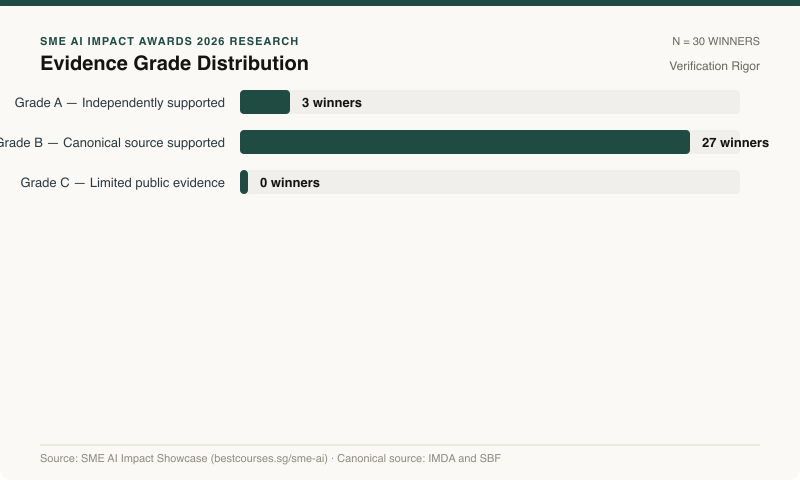
Only 12 of 30 winning implementations (40%) have verifiable third-party technical corroboration in mainstream news, vendor whitepapers, or client case studies outside the official government citation.

Grade A (Independently supported)

12 winners (40%)

Grade B (Canonical source only)

18 winners (60%)

Total cited sources

38 across 30 companies

Editorial context

A significant evidence gap persists between government award citations and verifiable public technical literature. While IMDA and SBF conducted site visits to verify claims, independent press coverage and public technical whitepapers remain scarce for most small enterprise AI deployments.

05

Time is the Universal Currency: 93% of winners measure time saved

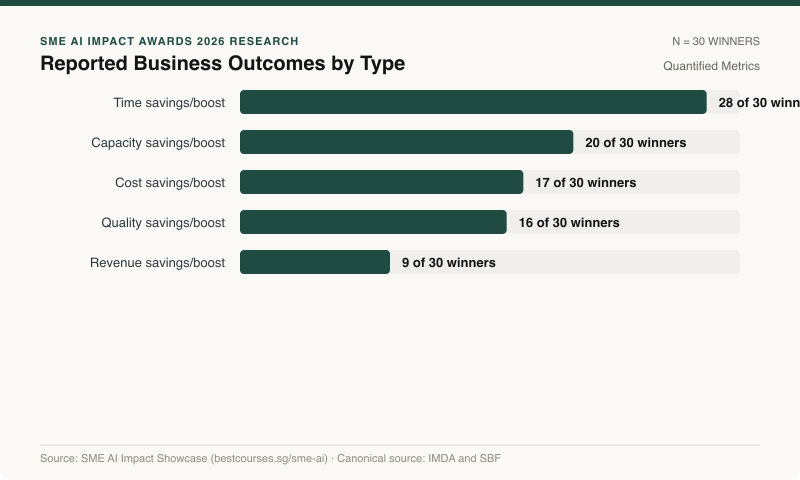
28 of 30 winners (93.3%) measured their primary impact in hours saved per day or percentage reduction in processing cycles, far outpacing direct headcount cuts or top-line revenue gains.

Reported time reduction

28 of 30 (93.3%)

Capacity expansion

20 of 30 (66.7%)

Direct revenue increase

9 of 30 (30.0%)

Editorial context

Amid tight labor market conditions in Singapore, SMEs view AI primarily as a labor capacity multiplier. Rather than replacing workers, successful deployments absorb transactional volume so existing teams can take on higher-value client work without headcount expansion.

Press Visual Assets

Downloadable Insights charts

High-resolution PNG charts formatted with source attributions for publication in print or online media.

Industry Sectors Distribution

Industry Sectors Distribution

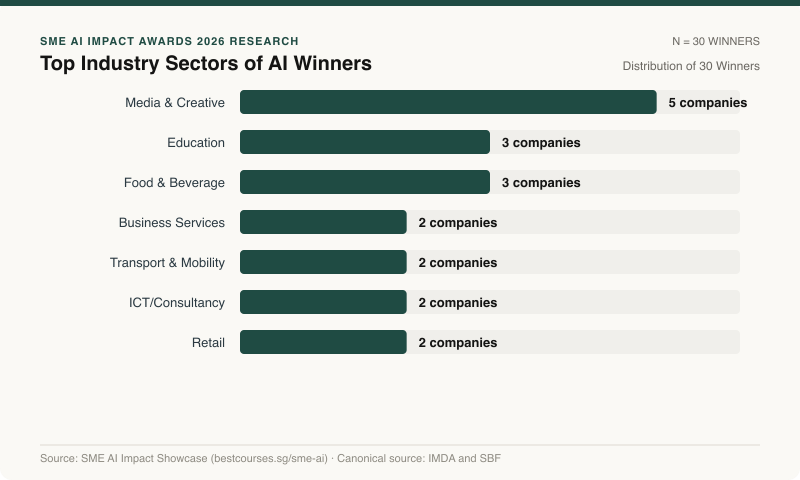
Breakdown of 30 winning companies across 21 industry sectors.

PNG · 800×480pxDownload image
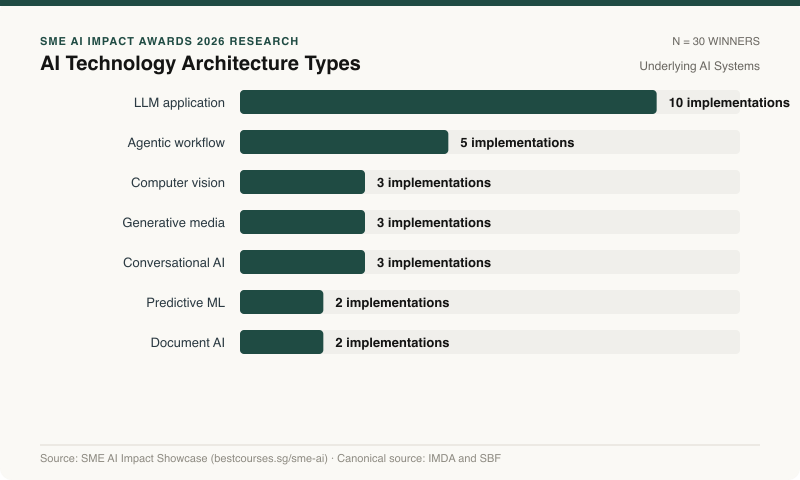
AI Technology Architecture Archetypes

AI Technology Architecture Archetypes

Distribution of LLM applications, agentic workflows, computer vision, and predictive ML.

PNG · 800×480pxDownload image
Reported Business Outcomes by Frequency

Reported Business Outcomes by Frequency

Quantified metrics reported across Time, Capacity, Cost, Quality, and Revenue.

PNG · 800×480pxDownload image
Evidence Grade Distribution

Evidence Grade Distribution

Rigor classification across Grade A (independently corroborated) and Grade B.

PNG · 800×480pxDownload image
Research Coverage Score Distribution

Research Coverage Score Distribution

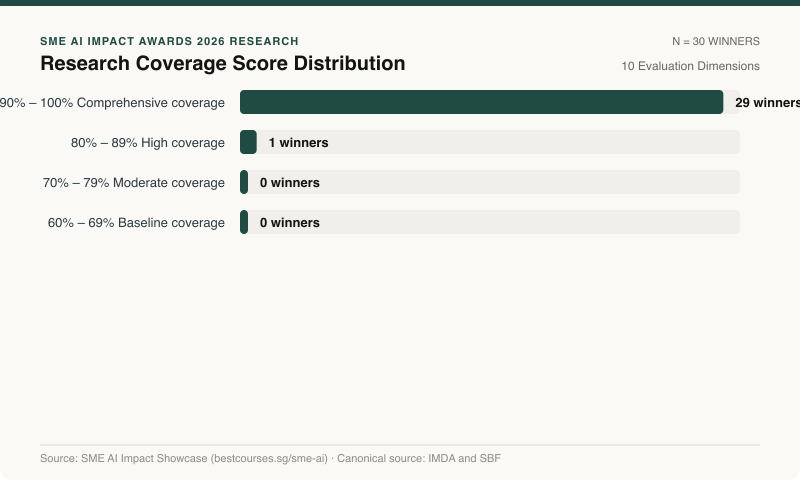
Percentage completeness across 10 evaluation dimensions (average 94%).

PNG · 800×480pxDownload image

Structured Data Access

Complete, ungated CSV and JSON dataset

Access the entire tabular dataset including 10-dimension evaluation coverage scores, named technology stacks, verified business metrics, and multi-tier source references.