Skip to content
SME AI Impact
Innovation ExcellenceICT/Consultancy· Platform engineering

Kyanon Digital

Kyanon Digital productised its AI delivery stack, cutting new engagement setup time by 83%.

Principal published result

83% reduction

Setup time for new AI engagements

Evidence grade

BCanonical source supported

Grade B — Canonical source supported

Research coverage

85% coverage

Ten evidence dimensions, not an AI maturity score

Sources

5

5 sources · 4 beyond T0

Open kyanon.digital ↗Live site, not an official page of this showcase.

Share on LinkedIn

01The official record

Award citation, verbatim in substance
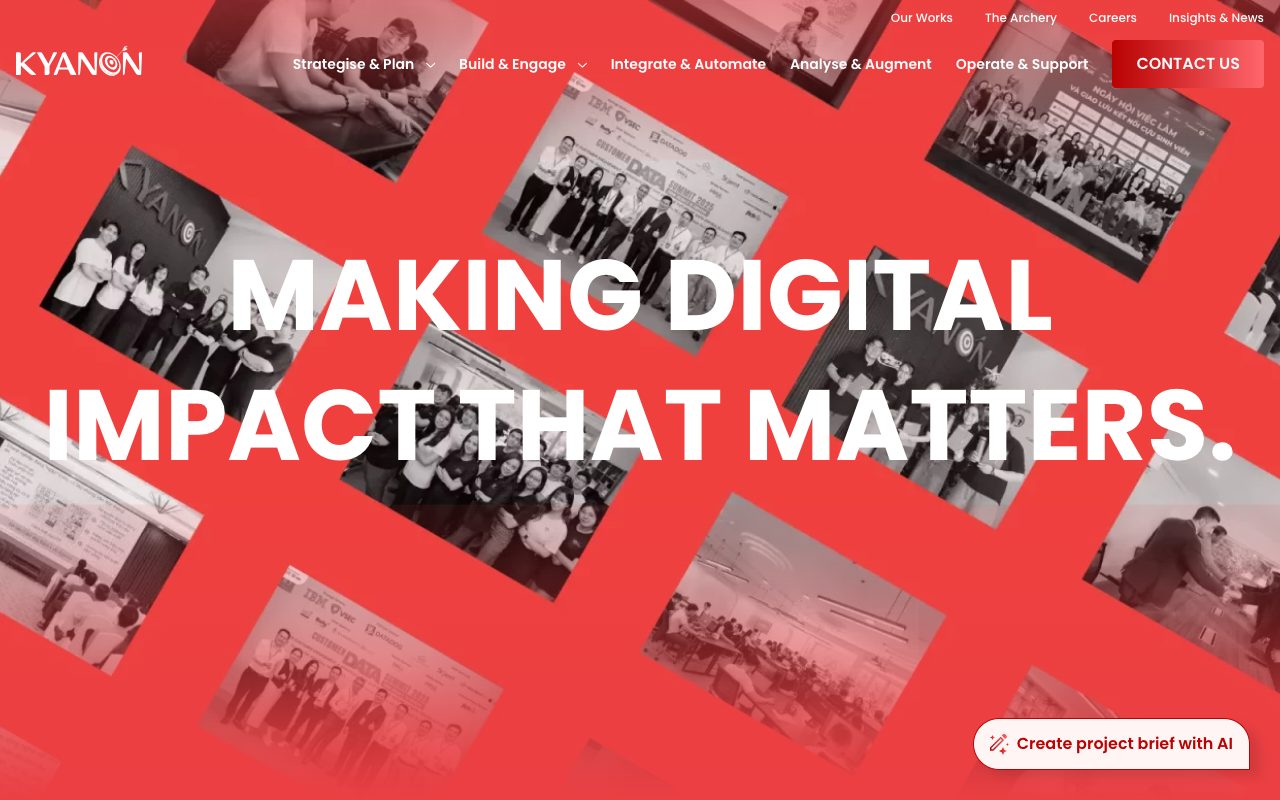
Homepage of Kyanon Digital, captured 2026-10-18
Kyanon Digital's homepage, captured 2026-10-18. Shown for identification and comment; it may differ from the award-winning implementation.Open live site ↗

Digital technology company and agile software development firm specialising in end-to-end digital transformation, data analytics, and enterprise IT solutions.

Published key challenges

  • Repetitive & long lead time for development work. Teams had to rebuild common capabilities for orchestral, retrieval, integrations, AI evaluation and monitoring before client-specific development could begin
  • Heavy reliance on AI engineers. Business-rules were embedded in application code with routine rule changes requiring around five working days of engineering effort, while AI quality checks also relied heavily on manual review
  • Limited planning flexibility. The company could support around four concurrent AI engagements without adding senior AI engineers at a similar rate, limiting its ability to grow efficiently even as demand increased

WisdomMind: Enterprise AI Platform

  • Reusable AI foundation: Shared capabilities for AI-agent orchestration, retrieval, integrations and deployment, allowing new engagements to start from proven platform capabilities instead of building from scratch
  • Governed business-rule management: Separates business rules from application code, allowing authorised teams to update rules directly while evaluation, versioning and approval controls are applied before changes reach production
  • Automated AI quality evaluation: Tests AI changes against defined ground-truth scenarios and business rules before deployment, helping teams identify regressions consistently
  • Reusable enterprise integrations: Provides shared integration and tool interfaces that can be built once and reused across AI agents and client engagements
  • End-to-end AI monitoring: Tracks AI execution, latency, errors and inference costs, giving teams visibility to diagnose issues and optimise production workloads

02SCQA case study

363 words
SSituation

Kyanon Digital is a digital technology company and agile software development firm specialising in digital transformation, data analytics and enterprise IT. It delivers AI work for client organisations. A third-party report in April 2026 records that its Kyanon Consulting unit, formed in 2025, serves retail, banking and manufacturing clients. Consultancy economics depend on how much of each engagement is genuinely new work.

CComplication

Teams rebuilt common capabilities for agent orchestration, retrieval, integrations, AI evaluation and monitoring before client-specific development could begin. Business rules were embedded in application code, so a routine rule change needed about five working days of engineering effort. AI quality checks depended heavily on manual review. The company could support around four concurrent AI engagements without adding senior AI engineers at the same rate. Demand could grow, but capacity could not, because each project started from zero. Senior engineers were therefore the constraint on revenue, and every new client competed for the same small group.

QQuestion

How could the firm stop rebuilding the same AI foundations on every engagement, and let non-engineers change business rules without a five-day code cycle?

AAnswer

Kyanon built WisdomMind, an enterprise AI platform that standardises core AI capabilities, business rules, integrations and quality controls. Teams start from a governed production framework and adapt it per client. A reusable foundation provides shared agent orchestration, retrieval, integrations and deployment. Governed business-rule management separates rules from application code, so authorised teams can update rules directly, with evaluation, versioning and approval applied before changes reach production. Automated quality evaluation tests AI changes against defined ground-truth scenarios and business rules before deployment, which catches regressions consistently rather than by inspection. Shared integration interfaces are built once and reused across agents and engagements. End-to-end monitoring tracks execution, latency, errors and inference cost. The citation reports 83% less setup time, business-rule changes 80 times faster, and 75% more concurrent delivery capacity. The citation does not report defect rates or client outcomes, so the platform's effect on delivery quality is not documented. The rule-change figure is the one that alters the commercial model, because it moves a task from engineering to operations without moving accountability, which is the difference between selling hours and selling a platform.

Implementation takeaway

If every project rebuilds retrieval, evaluation and monitoring, you are not selling AI. You are selling repeated setup.

03Verified business results

Company-reported
Published business outcomes for Kyanon Digital, as reported in the award citation.
MetricPublished resultAttribution
Setup time for new AI engagements83% reductionCompany-reported; published in the IMDA/SBF award citation
Business-rule changes80x fasterCompany-reported; published in the IMDA/SBF award citation
Concurrent AI delivery capacity75% increaseCompany-reported; published in the IMDA/SBF award citation

The award citation publishes relative changes and absolute volumes, not paired before-and-after values. Baseline figures are therefore not shown, and no improvement percentage has been calculated from them.

04Technology stack

Evidence status per layer
Technology stack for Kyanon Digital, with evidence status for each layer.
LayerImplementationVendor / in-houseEvidenceSource
AI modelModels used by client agents, routed through the platformNot disclosedunknownStatedT0-AWARDS
OrchestrationShared agent orchestration and retrieval capabilitiesIn-house, unnamedin-houseStatedT0-AWARDS
RulesBusiness rules separated from application code with versioning and approvalIn-house, unnamedin-houseStatedT0-AWARDS
EvaluationAutomated testing against ground-truth scenarios before deploymentIn-house, unnamedin-houseStatedT0-AWARDS
MonitoringExecution, latency, error and inference-cost trackingIn-house, unnamedin-houseStatedT0-AWARDS
IntegrationReusable enterprise integration and tool interfacesIn-house, unnamedin-houseStatedT0-AWARDS

A layer marked inferred includes a documented basis. Layers without a named vendor are left unnamed rather than filled with a plausible product.

05Implementation diagrams

Documented vs illustrative
Documented implementationEvidence-bounded
ClientengagementrequirementsReusable AIfoundationGoverned rulemanagementAutomatedqualityevaluationDeploymentExecution andcostmonitoringClient AIapplicationINPUTPROCESSAISYSTEMOUTPUT

Components named in the award citation.

Illustrative reference architectureIllustrative only
EngagementbriefReferenceimplementationtemplateRetrievalmoduleRuleconfigurationinterfaceRegressiontest suiteTracing andcostdashboardINPUTPROCESSAISYSTEMOUTPUT

A feasible build for another AI delivery firm. This is not Kyanon's production system.

06Unconfirmed — technical inference

Not attempted

No public technical details were identified beyond the official award description. This case is not supported well enough to justify a technical inference, so none is offered.

07How another SME could build something similar

Advisory, not the winner's method

This section is guidance for other companies. It is not a description of what Kyanon Digital did, and it is not endorsed by them.

Suitable for

  • · AI consultancies
  • · Systems integrators
  • · In-house platform teams serving several business units

Minimum requirements

  • · Two or three real projects to abstract from
  • · A test set of representative scenarios per domain
  • · Version control and approval workflow for rule changes

Three implementation paths

Level 1

Template library

Maintain reusable prompts, connectors and deployment scripts.

Use when: Fewer than five engagements a year.

Level 2

Shared platform

Centralise orchestration, retrieval and evaluation behind a configuration layer.

Use when: Repeatable engagement types emerge.

Level 3

Governed AI platform

Add rule versioning, approval gates, automated evaluation and cost monitoring.

Use when: Multiple delivery teams and regulated clients.

Suggested sequence

  1. 1Extract shared components from the second similar project, not the first
  2. 2Move business rules out of code into configuration
  3. 3Build a regression suite before enabling self-service rules
  4. 4Add cost and latency monitoring
  5. 5Measure setup time per engagement before and after

Tools and alternatives

  • · Agent orchestration framework
  • · Vector store
  • · Rules engine or configuration service
  • · Evaluation harness
  • · Observability stack

Risks and PDPA considerations

  • · Premature abstraction from a single project
  • · Rule changes that bypass evaluation
  • · Platform debt that clients inherit

KPIs to track

  • Days from contract to first working prototype
  • Rule change lead time
  • Regression escape rate
  • Concurrent engagements per senior engineer
  • Inference cost per engagement

08Research gaps

What remains unknown
  • No model vendor or cloud provider is named.
  • The 80x rule-change figure compares a five-day cycle with an unstated new cycle time.
  • Platform architecture is described only at capability level.

Are you this company? Submit documentation to upgrade your evidence grade.

If you have published technical documentation, vendor whitepapers, or third-party audits, submit documentation to our research desk. We update evidence grades upon verification.

09Sources

5 records
  1. Infocomm Media Development Authority (IMDA) and Singapore Business Federation (SBF) · 16 October 2026 · Retrieved 18 October 2026 · T0 — Canonical awards source

    Canonical source. Page last updated 16 October 2026. Publishes one profile per winner: company description, three key challenges, named AI solution, solution components and three headline metrics. No individual winner URLs are published.

  2. Infocomm Media Development Authority (IMDA) · 13 October 2026 · Retrieved 19 October 2026 · T1 — Direct primary source

    Official government media release for SMEs Go Digital Day 2026 and inaugural SME AI Impact Awards at Suntec Singapore Convention & Exhibition Centre. Minister Josephine Teo presented awards to 30 SMEs.

  3. Kyanon Digital · Retrieved 19 October 2026 · T1 — Direct primary source

    Company website detailing enterprise AI engineering, software development, data consulting, and digital transformation.

  4. PR Newswire APAC (IMDA media release) · 21 May 2026 · Retrieved 18 October 2026 · T1 — Direct primary source

    Announces the inaugural awards, the two categories, the 30-winner ceiling, the Trustmark, and the 13 October 2026 announcement date.

  5. Baijiahao · 10 April 2026 · Retrieved 18 October 2026 · T3 — Independent or supplementary

    States Kyanon Consulting, a Kyanon Digital unit formed in 2025, serves retail, banking and manufacturing clients. Used for company context only.

Researched 18 October 2026 · Updated 18 October 2026 · Award citation retrieved 18 October 2026.

Kyanon Digital is a winner of the SME AI Impact Awards 2026, organised by IMDA and SBF. This case study is independent analysis and is not an official company publication.

Related case studies

Similar technology and sector implementations

Homepage of McLink Asia, captured 2026-10-18
Adoption ExcellenceICT/Consultancy
Winner · Award Cohort 2026

McLink Asia

McLink Asia put specialised agents on marketing work and tripled campaign production capacity.

Campaign production capacity
200% increase
Workflow automationBCanonical source supported
Homepage of Best Marketing Agency, captured 2026-10-18
Innovation ExcellenceMedia & Creative
Winner · Award Cohort 2026

Best Marketing Agency

Best Marketing Agency rebuilt its agency operating model around AI agents, and revenue per employee rose 71%.

Revenue per employee
71% increase
Workflow automationBCanonical source supported
Homepage of Glints Singapore, captured 2026-10-18
Innovation ExcellenceTalent & Recruitment
Winner · Award Cohort 2026

Glints Singapore

Glints cut internal fact-finding time by 90% with an agent that reads its own systems and source code.

Time spent fact-finding
90% reduction
Knowledge retrievalBCanonical source supported