IYLA Collective
IYLA Collective used Claude and Claude Code to quadruple content output and save S$14,000 in annual labour.
- Annual recurring labour
- More than $14,000 saved
Limteh Project reads personalised gift orders with AI and cut rework on orders by 80%.
Principal published result
80% less
Rework on orders
Evidence grade
Grade B — Canonical source supported
Research coverage
Ten evidence dimensions, not an AI maturity score
Sources
3
3 sources · 2 beyond T0
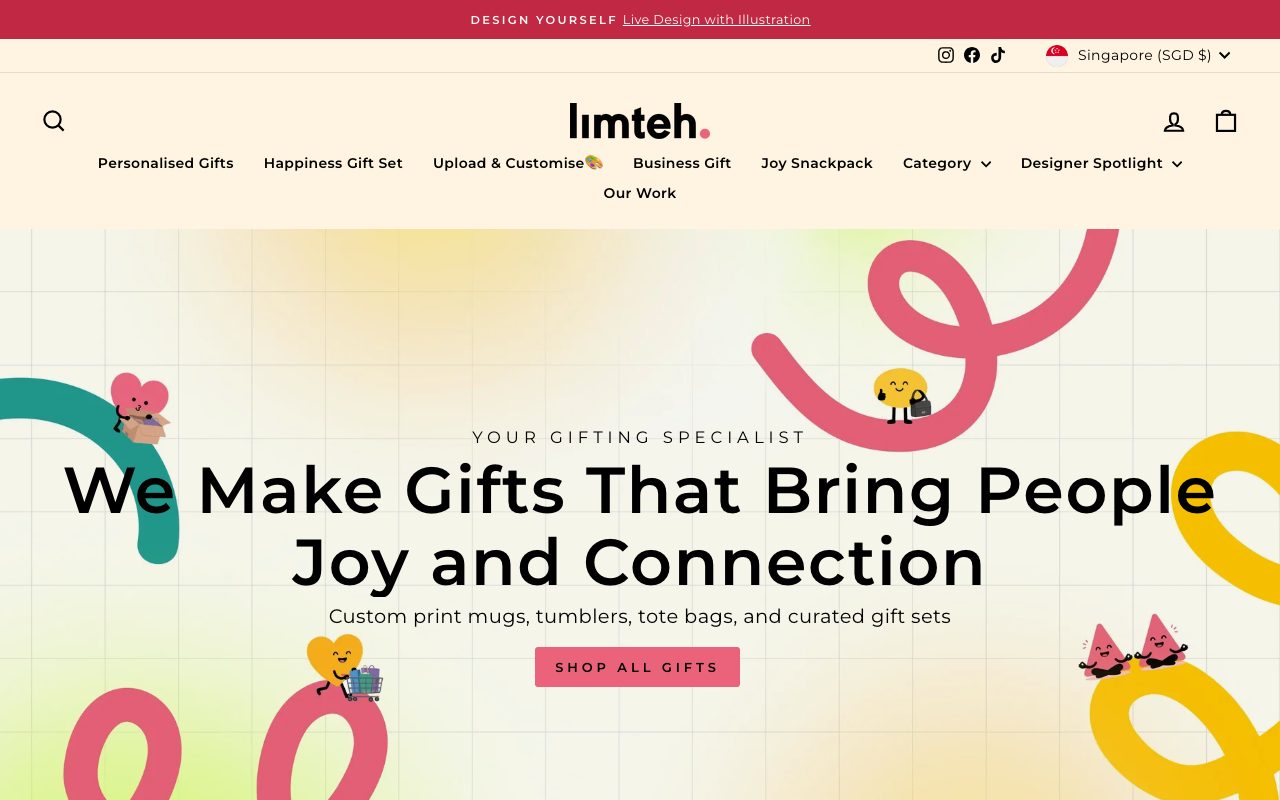
Open limtehproject.com ↗Live site, not an official page of this showcase.

Creates customised corporate gifts, gift sets and personalised presents
Limteh Project creates customised corporate gifts, gift sets and personalised presents. Each order carries customer-specific text, names, logos or artwork. The business runs on marketplaces and chat channels, so the personalisation instruction arrives as free text in whichever channel the customer used.
Personalisation details arrived through order notes, customer chats and messages, sometimes in different languages. Staff processed around 2,500 orders a month by hand, which created a daily production bottleneck. Order mistakes produced reprints, reshipping, wasted materials and unhappy customers. In a made-to-order business, an error found after printing cannot be corrected cheaply, because the material is already consumed. Staff time was also the constraint on customer service, because the same people answered enquiries, prepared production files and chased artwork approvals, so a busy week in production became a slow week for customers.
How could the company interpret thousands of free-text personalisation requests accurately enough to send straight to production, without a person retyping every order?
Limteh built Milo, an AI order automation system that carries personalised orders from sales to production. It reads orders and marketplace chats to identify each customer's personalisation requirements. It turns those requirements into production instructions and automates print-file preparation. A verification step cross-checks order details and flags uncertain orders for staff review, which keeps a person on the ambiguous cases rather than on every case. The system learns from staff corrections, so accuracy improves with use. Beyond production, it automates sales reporting, stock alerts, profit-and-loss dashboards and marketing content creation. The published result is 80% less rework on orders, more than 20 hours saved each week, and up to $5,800 saved monthly. The pattern is a narrow, high-value extraction task with a human exception queue, rather than a general assistant. The design also keeps a person on the ambiguous cases rather than on every case, which is what makes the throughput gain compatible with made-to-order accuracy at this volume. The monthly saving is small in absolute terms, which is precisely why it matters here: at this order volume the fix had to be cheap enough to justify itself quickly, and a large platform investment would not have paid back.
Implementation takeaway
In made-to-order production, accuracy is cheaper than speed. Route uncertain orders to a person before the printer starts.
| Metric | Published result | Attribution |
|---|---|---|
| Rework on orders | 80% less | Company-reported; published in the IMDA/SBF award citation |
| Staff time | More than 20 hours saved each week | Company-reported; published in the IMDA/SBF award citation |
| Cost | Up to $5,800 saved monthly | Company-reported; published in the IMDA/SBF award citation |
The award citation publishes relative changes and absolute volumes, not paired before-and-after values. Baseline figures are therefore not shown, and no improvement percentage has been calculated from them.
| Layer | Implementation | Vendor / in-house | Evidence | Source |
|---|---|---|---|---|
| AI model | Language model for order interpretation and verification | Not disclosedunknown | Stated | T0-AWARDS |
| Processing | Production instruction generation and automated print-file preparation for heat press and engraving | In-house, unnamedin-house | Stated | T0-AWARDST1-LIMTEH-SITE |
| Integration | Marketplace chat and order channels across Shopee, Lazada and e-commerce storefront | Shopee, Lazada, Shopifyvendor | Stated | T0-AWARDST1-LIMTEH-SITE |
| Feedback | Learning from staff corrections | In-house, unnamedin-house | Stated | T0-AWARDS |
| Reporting | Sales reporting, stock alerts and P&L dashboards | In-house, unnamedin-house | Stated | T0-AWARDS |
A layer marked inferred includes a documented basis. Layers without a named vendor are left unnamed rather than filled with a plausible product.
Components named in the award citation.
A feasible build for another made-to-order business. This is not Limteh's production system.
No public technical details were identified beyond the official award description. This case is not supported well enough to justify a technical inference, so none is offered.
This section is guidance for other companies. It is not a description of what Limteh Project did, and it is not endorsed by them.
Level 1
Structured order form
Constrain customer input with a form so personalisation arrives as fields, not prose.
Use when: Customers can be guided at the point of order.
Level 2
Assisted extraction
Extract fields from free text and route low-confidence orders to staff.
Use when: Orders arrive through marketplaces and chat.
Level 3
Automated production handoff
Generate print-ready files automatically, with verification and a correction feedback loop.
Use when: Accuracy is proven and volume justifies integration.
Are you this company? Submit documentation to upgrade your evidence grade.
If you have published technical documentation, vendor whitepapers, or third-party audits, submit documentation to our research desk. We update evidence grades upon verification.
Infocomm Media Development Authority (IMDA) and Singapore Business Federation (SBF) · 16 October 2026 · Retrieved 18 October 2026 · T0 — Canonical awards source
Canonical source. Page last updated 16 October 2026. Publishes one profile per winner: company description, three key challenges, named AI solution, solution components and three headline metrics. No individual winner URLs are published.
Infocomm Media Development Authority (IMDA) · 13 October 2026 · Retrieved 19 October 2026 · T1 — Direct primary source
Official government media release for SMEs Go Digital Day 2026 and inaugural SME AI Impact Awards at Suntec Singapore Convention & Exhibition Centre. Minister Josephine Teo presented awards to 30 SMEs.
Limteh Project Pte Ltd · Retrieved 19 October 2026 · T1 — Direct primary source
Company website detailing personalised corporate gifts, bespoke drinkware, and made-to-order production workflows.
Researched 18 October 2026 · Updated 18 October 2026 · Award citation retrieved 18 October 2026.
Limteh Project is a winner of the SME AI Impact Awards 2026, organised by IMDA and SBF. This case study is independent analysis and is not an official company publication.
Related case studies

IYLA Collective used Claude and Claude Code to quadruple content output and save S$14,000 in annual labour.

Accountingbpo turned a headcount-bound accounting back office into a supervised AI workflow.

iAPPS Health Group built an AI-native clinic operating system and lifted doctor productivity up to four times.