Mencast Marine
Mencast used AI to explore thousands of propulsion designs, and generated S$900,000 in new revenue.
- Design turnaround
- 50% faster
Blue Aqua put predictive AI on pond data and cut production cost by around 30%.
Principal published result
30% improvement
Production cost management
Evidence grade
Grade A — Independently supported
Research coverage
Ten evidence dimensions, not an AI maturity score
Sources
3
3 sources · 2 beyond T0
Open www.blueaquaint.com ↗Live site, not an official page of this showcase.

Provides sustainable aquaculture, animal nutrition and farm management solutions to farmers worldwide
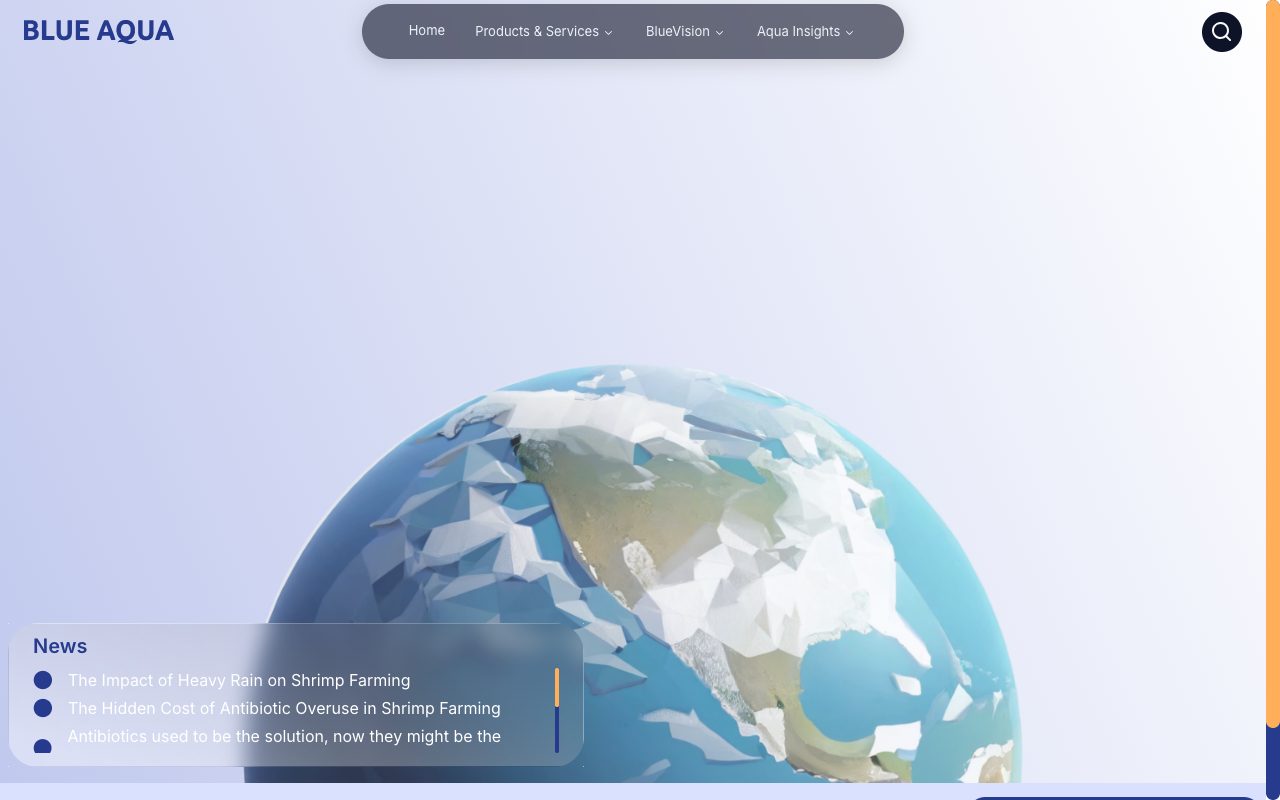
Blue Aqua International provides sustainable aquaculture, animal nutrition and farm management solutions to farmers worldwide. The Singapore Food Agency records that the company runs a local hatchery nurturing more than 100 million post-larval shrimp a year. Shrimp farming is a biological operation with thin margins: feed is a major cost, water conditions change faster than manual checks, and disease can spread through a pond before it is visible.
Water quality was checked infrequently, so problems could develop undetected between readings. Feeding was generic rather than matched to the pond, which wasted feed and money, and late disease detection raised the risk of stock loss. Decisions depended heavily on individual experience, paper logs and inconsistent records, which made performance hard to compare across farms. Expertise therefore did not scale: each farm's results depended on who was managing it. A farm manager's departure took the operating knowledge with them, and the company had no consistent way to compare one pond's performance against another.
How could the company convert scattered pond observations and individual experience into consistent, early warnings that any farm team could act on?
The company built AquaPilot, an aquaculture intelligence platform that analyses water quality, feeding, health and production data. Deployed across farm operations for approximately 1.5 years at the time of reporting, the system forecasts dissolved oxygen, ammonia and temperature six to 24 hours ahead using sensor and biological data, alerting teams to emerging water anomalies. It generates daily pond-level disease risk scores, delivering advance warnings four to seven days before health issues typically become visible. Feed calculations are pond-specific, dynamically weighing biomass, water conditions, growth trajectories and health risk. According to CEO Farshad Shishehchian in The Straits Times, this predictive feeding regime improved shrimp feeding efficiency by about 30%, adding operational specificity to the citation's broader 30% production cost management result. The system also monitors the recirculating aquaculture system, predicting equipment issues and adjusting feeding in response. A benchmarking layer compares ponds on feed conversion, survival, growth and cost, returning farm-specific recommendations. The published result is a 30% improvement in production cost management, survival rates 6 to 9 percentage points higher, and around 2,500 manpower hours saved each year. The survival-rate range is the more telling number, because it moves a biological outcome rather than a cost line, and biological outcomes are harder to attribute to any single management change than a feed bill is.
Implementation takeaway
The model is the easy part. The value sits in turning sensor readings into a daily decision that a farm hand can act on before the loss happens.
| Metric | Published result | Attribution |
|---|---|---|
| Production cost management | 30% improvement | Company-reported; published in the IMDA/SBF award citation |
| Shrimp feeding efficiency | Improved by about 30% | Reported by Blue Aqua CEO Farshad Shishehchian to The Straits Times; provides a specific operational measure behind the broader production-cost result |
| Advance risk warning lead-time | 4–7 days earlier | Advance warning lead-time for water-quality anomalies and disease risks, published in award citation and corroborated by The Straits Times |
| Shrimp survival rate | 6–9% higher | Company-reported; published in the IMDA/SBF award citation |
| Manpower | Around 2,500 hours saved annually | Company-reported; published in the IMDA/SBF award citation |
The award citation publishes relative changes and absolute volumes, not paired before-and-after values. Baseline figures are therefore not shown, and no improvement percentage has been calculated from them.
| Layer | Implementation | Vendor / in-house | Evidence | Source |
|---|---|---|---|---|
| AI model | Forecasting for water quality and daily disease risk scoringBasis: Detailed in award citation and corroborated by The Straits Times reporting on predictive disease alerts. | In-house, unnamedin-house | Corroborated | T0-AWARDST3-ST-AWARDS |
| Sensing | Pond sensors feeding water quality, biological data and farm recordsBasis: Reported in citation and confirmed in Straits Times coverage of sensor and water data inputs. | Not disclosedunknown | Corroborated | T0-AWARDST3-ST-AWARDS |
| Processing | Feed requirement calculation per pond achieving ~30% feeding efficiency gainBasis: Named in citation and independently reported by CEO in The Straits Times. | In-house, unnamedin-house | Corroborated | T0-AWARDST3-ST-AWARDS |
| Integration | Recirculating aquaculture system monitoring and control | Not disclosedunknown | Stated | T0-AWARDS |
| Analytics | Pond benchmarking on feed conversion, survival, growth and cost | In-house, unnamedin-house | Stated | T0-AWARDS |
| Governance | Not described in any public source | Not disclosedunknown | Stated | T0-AWARDS |
A layer marked inferred includes a documented basis. Layers without a named vendor are left unnamed rather than filled with a plausible product.
Components named in the award citation.
A feasible build for another aquaculture operator. This is not the company's production system.
No public technical details were identified beyond the official award description. This case is not supported well enough to justify a technical inference, so none is offered.
This section is guidance for other companies. It is not a description of what Blue Aqua International did, and it is not endorsed by them.
Level 1
Threshold alerting
Sensors with simple rules that message the farm team when a reading leaves range.
Use when: No data history yet and losses come from undetected extremes.
Level 2
Forecast and risk scoring
Add short-horizon forecasts and a daily risk score using historical pond data.
Use when: One year of clean sensor and outcome data exists.
Level 3
Closed-loop optimisation
Connect forecasts to feed and aeration setpoints with human override.
Use when: Actuation is instrumented and the team trusts the model.
Are you this company? Submit documentation to upgrade your evidence grade.
If you have published technical documentation, vendor whitepapers, or third-party audits, submit documentation to our research desk. We update evidence grades upon verification.
Infocomm Media Development Authority (IMDA) and Singapore Business Federation (SBF) · 16 October 2026 · Retrieved 18 October 2026 · T0 — Canonical awards source
Canonical source. Page last updated 16 October 2026. Publishes one profile per winner: company description, three key challenges, named AI solution, solution components and three headline metrics. No individual winner URLs are published.
Singapore Food Agency (SFA), From SG to SG · Retrieved 18 October 2026 · T1 — Direct primary source
Government profile. States the company operates a local hatchery that nurtures over 100 million post-larval shrimp a year.
The Straits Times · 16 October 2026 · Retrieved 19 October 2026 · T3 — Independent or supplementary
Mainstream independent news coverage of the inaugural awards ceremony. Reports on 290 nominations across 21 sectors and provides in-depth operational reporting on Blue Aqua International (30% shrimp feed efficiency improvement, 4-7 days advance water-quality/disease warnings, 1.5 years operational tenure) and Agape Connecting People (real-time caller sentiment analysis and customer profiling informed by past calls across agents, including its contact centre inside Changi Women's Prison).
Researched 18 October 2026 · Updated 18 October 2026 · Award citation retrieved 18 October 2026.
Blue Aqua International is a winner of the SME AI Impact Awards 2026, organised by IMDA and SBF. This case study is independent analysis and is not an official company publication.
Related case studies

Mencast used AI to explore thousands of propulsion designs, and generated S$900,000 in new revenue.

Accountingbpo turned a headcount-bound accounting back office into a supervised AI workflow.

Best Marketing Agency rebuilt its agency operating model around AI agents, and revenue per employee rose 71%.