TTS Group
TTS Group replaced manual traffic counts with computer vision, processing about 50 times more sites a month.
- Traffic-data acquisition capacity
- About 98% increase
GetGo uses computer vision to attribute car damage to the right booking, recovering S$20,000 in two months.
Principal published result
53% reduction
Damage-to-invoice lead time
Evidence grade
Grade B — Canonical source supported
Research coverage
Ten evidence dimensions, not an AI maturity score
Sources
2
2 sources · 1 beyond T0
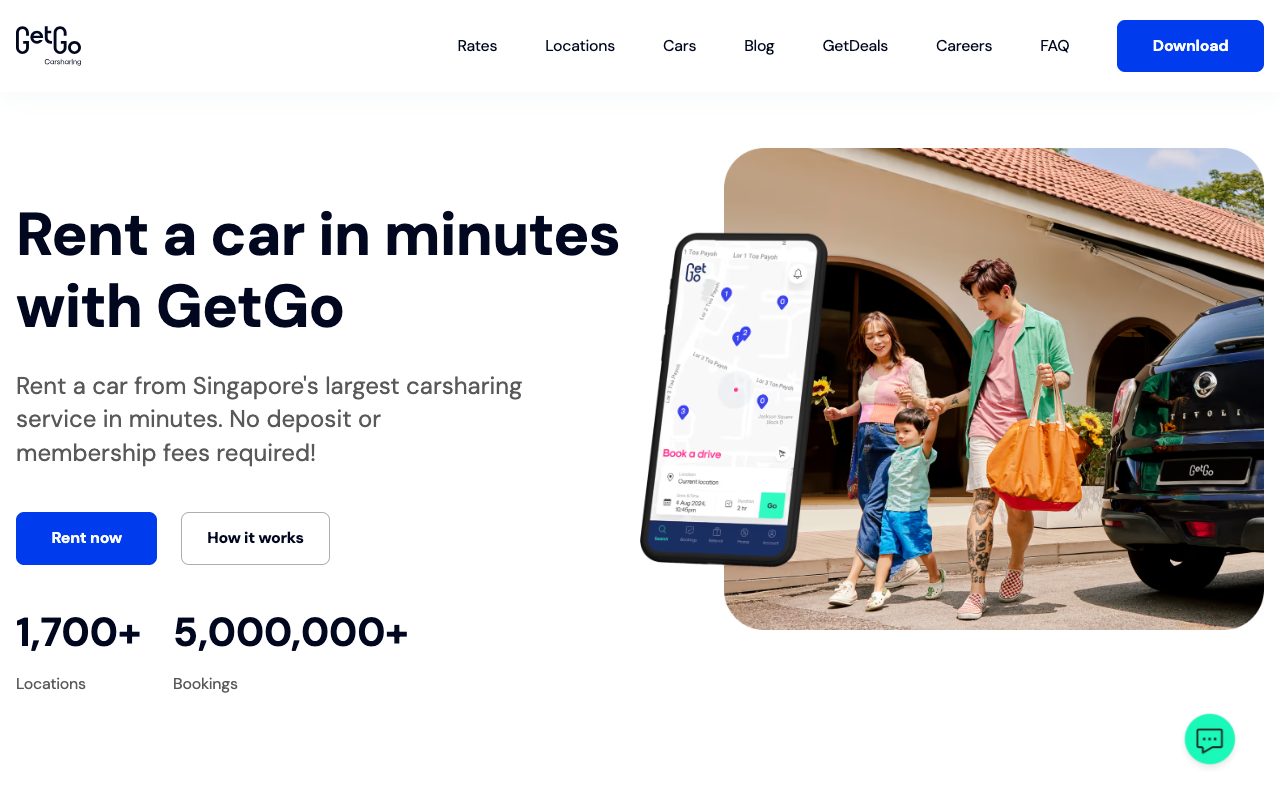
Open getgo.sg ↗Live site, not an official page of this showcase.

Provides on-demand carsharing on a pay-as-you-drive basis
GetGo Technologies runs an on-demand carsharing service on a pay-as-you-drive basis. A vendor case study published by Zendesk in 2024 records that the fleet exceeded 2,400 cars across more than 1,500 locations. Every rental begins and ends with photographs of the vehicle, taken by the customer. Those photographs are the only record of the vehicle's condition at the moment of handover.
The citation states that around 7,000 daily bookings generate about 56,000 end-trip photographs. Inspecting every booking manually is not feasible at that ratio. Damage could therefore go unnoticed until a customer reported it or a workshop found it days or weeks later. Late detection broke the link between damage and the booking that caused it, so the cost of repair could not be recovered from the responsible renter. The company carried the loss, and the invoice for damage arrived long after the rental ended. The company also carried the cost of disputes, because a charge raised weeks later is harder to defend than one raised at handover.
How could GetGo inspect tens of thousands of handover photographs a day, decide which booking caused any damage, and bill it accurately without accusing the wrong customer?
GetGo built Project Desmond, a damage detection system that combines computer vision, image matching and human validation. It analyses end-trip photographs and detects billable damage such as scratches, dents, cracks and dangling parts. It then compares consecutive bookings to establish when damage first appeared, and uses image embeddings to judge whether a detected defect is new or a recurring one already on file. Flagged cases route to human reviewers, who validate before any case proceeds to follow-up and billing. The model is retrained on real failure cases, including rain and reflections, to raise precision and cut false positives. The citation reports a 53% reduction in the lead time from damage to invoice, 60% less manual review work, and S$20,000 recovered in two months. The design keeps a person between the model and the customer, which matters when the output becomes a charge. The citation does not publish the model's precision or the dispute rate, so the commercial effect of a false positive is not documented. The recovered amount is a floor rather than a ceiling, because it measures only damage billed within two months, and says nothing about damage prevented, disputes avoided, or repairs found before a vehicle left the lot.
Implementation takeaway
When AI output becomes a bill, the review step is not overhead. It is the control that makes the automation usable.
| Metric | Published result | Attribution |
|---|---|---|
| Damage-to-invoice lead time | 53% reduction | Company-reported; published in the IMDA/SBF award citation |
| Manual review workload | 60% less | Company-reported; published in the IMDA/SBF award citation |
| Damage costs recovered | S$20,000 within two months | Company-reported; published in the IMDA/SBF award citation |
The award citation publishes relative changes and absolute volumes, not paired before-and-after values. Baseline figures are therefore not shown, and no improvement percentage has been calculated from them.
| Layer | Implementation | Vendor / in-house | Evidence | Source |
|---|---|---|---|---|
| AI model | Computer vision model for damage classification, retrained on failure cases | In-house, unnamedin-house | Stated | T0-AWARDS |
| Matching | Image embeddings for new-versus-recurring damage comparison | In-house, unnamedin-house | Stated | T0-AWARDS |
| Processing | Booking-level attribution across consecutive rentals | In-house, unnamedin-house | Stated | T0-AWARDS |
| Integration | Booking records linked to damage cases and billing | Not disclosedunknown | Stated | T0-AWARDS |
| Governance | Human validation before confirmed cases proceed to billing | In-house, unnamedin-house | Stated | T0-AWARDS |
A layer marked inferred includes a documented basis. Layers without a named vendor are left unnamed rather than filled with a plausible product.
Components named in the award citation.
A feasible build for another fleet operator. This is not GetGo's production system.
No public technical details were identified beyond the official award description. This case is not supported well enough to justify a technical inference, so none is offered.
This section is guidance for other companies. It is not a description of what GetGo Technologies did, and it is not endorsed by them.
Level 1
Guided capture and manual review
Standardise photographs and compare them side by side in a review tool.
Use when: Fleet is small and disputes are the main problem.
Level 2
Assisted detection
Use a managed vision API to pre-flag likely damage, with every case reviewed by a person.
Use when: Photo volume exceeds manual capacity.
Level 3
Attribution and billing
Add embedding-based comparison across handovers and integrate decisions into billing.
Use when: Detection precision is proven and recovery value justifies the build.
Are you this company? Submit documentation to upgrade your evidence grade.
If you have published technical documentation, vendor whitepapers, or third-party audits, submit documentation to our research desk. We update evidence grades upon verification.
Infocomm Media Development Authority (IMDA) and Singapore Business Federation (SBF) · 16 October 2026 · Retrieved 18 October 2026 · T0 — Canonical awards source
Canonical source. Page last updated 16 October 2026. Publishes one profile per winner: company description, three key challenges, named AI solution, solution components and three headline metrics. No individual winner URLs are published.
Zendesk · 4 January 2024 · Retrieved 18 October 2026 · T2 — Named implementation partner
Vendor case study naming GetGo. States GetGo operates more than 2,400 cars across more than 1,500 locations. Concerns customer support, not damage detection.
Researched 18 October 2026 · Updated 18 October 2026 · Award citation retrieved 18 October 2026.
GetGo Technologies is a winner of the SME AI Impact Awards 2026, organised by IMDA and SBF. This case study is independent analysis and is not an official company publication.
Related case studies

TTS Group replaced manual traffic counts with computer vision, processing about 50 times more sites a month.

Greenphyto runs a 23-metre indoor farm on computer vision, cutting crop inspection time tenfold.

Accountingbpo turned a headcount-bound accounting back office into a supervised AI workflow.