Skip to content
SME AI Impact
Innovation ExcellenceMarine and Offshore Energy· Design optimisation

Mencast Marine

Mencast used AI to explore thousands of propulsion designs, and generated S$900,000 in new revenue.

Principal published result

50% faster

Design turnaround

Evidence grade

BCanonical source supported

Grade B — Canonical source supported

Research coverage

90% coverage

Ten evidence dimensions, not an AI maturity score

Sources

2

2 sources · 1 beyond T0

Open www.mencast.com.sg ↗Live site, not an official page of this showcase.

Share on LinkedIn

01The official record

Award citation, verbatim in substance
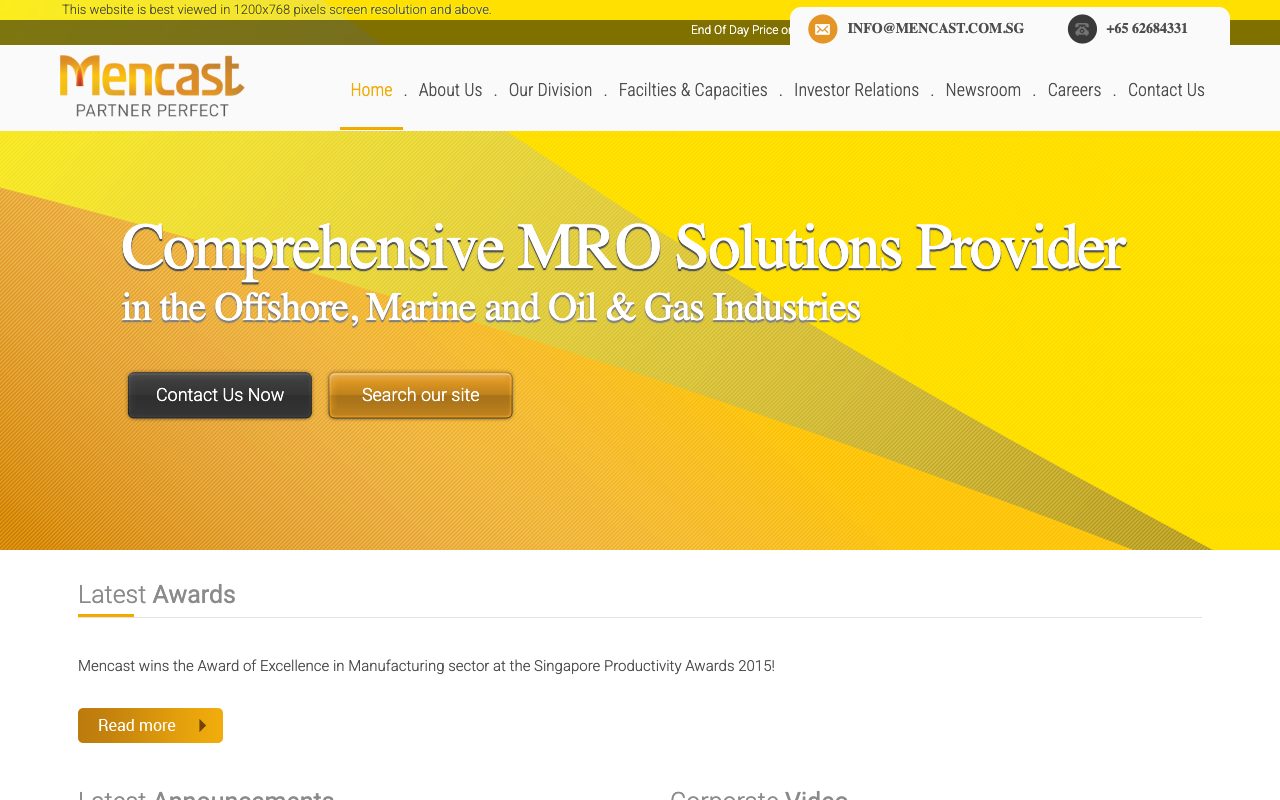
Homepage of Mencast Marine, captured 2026-10-18
Mencast Marine's homepage, captured 2026-10-18. Shown for identification and comment; it may differ from the award-winning implementation.Open live site ↗

Provides marine propulsion design, manufacturing and repair for the global marine and offshore industry

Published key challenges

  • Time-consuming design process. Conventional methods restrict the number of options engineers could evaluate, slowing complex projects
  • Pressure to lower design costs. Growing competition from lower-cost players reduced margins and placed pressure on Mencast's design-led business
  • Labour-intensive and manual operations. Lengthy production cycles and manual information retrieval slowed quotations, workflows and operational efficiency

Mencast AI Platform (MAIP)

  • AI-powered propulsion design: Analyses thousands of design possibilities to identify higher-performing options and shorten the design process
  • Design differentiation: Leverages decades of engineering and sea-trial data to develop differentiated propulsion solutions beyond competing primarily on price
  • Intelligent manufacturing optimisation: Combines AI, computer vision and sensors to improve quality and support more efficient production
  • Enterprise knowledge automation: Organises enterprise knowledge and automates workflows such as quotations, claims processing, research and information retrieval

02SCQA case study

353 words
SSituation

Mencast Marine provides marine propulsion design, manufacturing and repair for the global marine and offshore industry. Its design work draws on decades of engineering and sea-trial data. The company competes in a market where lower-cost suppliers can replicate standard designs, so differentiation has to come from engineering judgement applied to a specific vessel.

CComplication

Conventional design methods restricted the number of options engineers could evaluate, which slowed complex projects. Competition from lower-cost players compressed margins and put pressure on a design-led business. Production cycles were long, and manual information retrieval slowed quotations, claims processing and research. The constraint was not engineering capability. It was the number of design options a small team could explore, and the time spent finding information that already existed inside the company. Quotation delays cost orders in a market where the buyer is comparing several suppliers on response time.

QQuestion

How could a mid-sized propulsion designer evaluate far more design options per project and speed up quotation work, without hiring a larger engineering team?

AAnswer

Mencast built the Mencast AI Platform, MAIP, which combines AI, computer vision and enterprise knowledge automation. AI-powered propulsion design analyses thousands of design possibilities to identify higher-performing options and shortens the design process. Design differentiation uses decades of engineering and sea-trial data, so the firm can offer solutions beyond price competition. Intelligent manufacturing optimisation combines AI, computer vision and sensors to improve quality and support more efficient production. Enterprise knowledge automation organises company knowledge and automates workflows including quotations, claims processing, research and information retrieval. The published result is 50% faster design turnaround, 75% higher productivity on knowledge-intensive tasks, and $900,000 in new revenue within 18 months. The revenue figure matters more than the efficiency figures, because it shows the capability was sold, not only used internally. The citation does not state how design options are validated, so it is not clear whether the model replaces simulation or only ranks candidates for it. The revenue figure is the strongest evidence in the citation, because it is the only one that shows an external buyer paying for the capability, rather than the company measuring its own internal efficiency.

Implementation takeaway

Point AI at the work you already charge for. Design exploration and quotation speed convert directly into won contracts.

03Verified business results

Company-reported
Published business outcomes for Mencast Marine, as reported in the award citation.
MetricPublished resultAttribution
Design turnaround50% fasterCompany-reported; published in the IMDA/SBF award citation
Productivity on knowledge-intensive tasks75% higherCompany-reported; published in the IMDA/SBF award citation
New revenue$900,000 within 18 monthsCompany-reported; published in the IMDA/SBF award citation

The award citation publishes relative changes and absolute volumes, not paired before-and-after values. Baseline figures are therefore not shown, and no improvement percentage has been calculated from them.

04Technology stack

Evidence status per layer
Technology stack for Mencast Marine, with evidence status for each layer.
LayerImplementationVendor / in-houseEvidenceSource
AI modelDesign-space search and evaluation over propulsion parametersIn-house, unnamedin-houseStatedT0-AWARDS
Computer visionVision and sensors for manufacturing qualityNot disclosedunknownStatedT0-AWARDS
KnowledgeEnterprise knowledge organisation and retrievalIn-house, unnamedin-houseStatedT0-AWARDS
DataEngineering and sea-trial records used as design inputIn-house, unnamedin-houseStatedT0-AWARDS
AutomationQuotation, claims and research workflowsIn-house, unnamedin-houseStatedT0-AWARDS
GovernanceNot described in any public sourceNot disclosedunknownStatedT0-AWARDS

A layer marked inferred includes a documented basis. Layers without a named vendor are left unnamed rather than filled with a plausible product.

05Implementation diagrams

Documented vs illustrative
Documented implementationEvidence-bounded
Vesselrequirementsand…Design-spacesearchEnterpriseknowledgeautomationVision-assistedmanufacturingEngineerselection andsign-offPropulsiondesign andquotationINPUTPROCESSAIHUMANOUTPUT

Components named in the award citation.

Illustrative reference architectureIllustrative only
Parameteriseddesign modelDesign-spacesamplerPerformancesimulationSurrogatemodelEngineerreviewShortlisteddesignsPROCESSAISYSTEMHUMANOUTPUT

A feasible build for another engineering firm. This is not Mencast's production system.

06Unconfirmed — technical inference

Not attempted

No public technical details were identified beyond the official award description. This case is not supported well enough to justify a technical inference, so none is offered.

07How another SME could build something similar

Advisory, not the winner's method

This section is guidance for other companies. It is not a description of what Mencast Marine did, and it is not endorsed by them.

Suitable for

  • · Marine and offshore engineering
  • · Precision manufacturing
  • · HVAC and mechanical design
  • · Any business with a parameterised design process

Minimum requirements

  • · A parameterised design model or CAD that can be driven programmatically
  • · Historical performance data tied to design parameters
  • · Engineers willing to validate model output

Three implementation paths

Level 1

Knowledge retrieval

Index past projects and specifications so engineers can find prior work.

Use when: Information retrieval is the main delay.

Level 2

Design-space exploration

Script the parametric model and run automated sweeps with a surrogate model.

Use when: Design parameters and performance data exist.

Level 3

Integrated engineering platform

Join design search, manufacturing vision and workflow automation in one governed platform.

Use when: Multiple engineering and production teams need shared data.

Suggested sequence

  1. 1Define the design parameters and the performance objective
  2. 2Run a structured design-of-experiments sweep
  3. 3Train a surrogate model to predict performance cheaply
  4. 4Compare surrogate rankings with physical or simulated results
  5. 5Keep an engineer's signature on every released design

Tools and alternatives

  • · Parametric CAD or simulation tool with scripting
  • · Design-of-experiments library
  • · Surrogate modelling framework
  • · Internal document retrieval

Risks and PDPA considerations

  • · Surrogate model extrapolating outside the validated range
  • · Historical data reflecting obsolete designs
  • · Knowledge automation returning superseded specifications

KPIs to track

  • Designs evaluated per project
  • Days from brief to shortlist
  • Quotation turnaround
  • Win rate
  • Engineering hours per project

08Research gaps

What remains unknown
  • No model, CAD or cloud vendor is named.
  • Currency is published as '$' without specifying Singapore or US dollars.
  • Sea-trial data volume and model validation are not described.

Are you this company? Submit documentation to upgrade your evidence grade.

If you have published technical documentation, vendor whitepapers, or third-party audits, submit documentation to our research desk. We update evidence grades upon verification.

09Sources

2 records
  1. Infocomm Media Development Authority (IMDA) and Singapore Business Federation (SBF) · 16 October 2026 · Retrieved 18 October 2026 · T0 — Canonical awards source

    Canonical source. Page last updated 16 October 2026. Publishes one profile per winner: company description, three key challenges, named AI solution, solution components and three headline metrics. No individual winner URLs are published.

  2. Singapore Economic Development Board (EDB) · 20 August 2026 · Retrieved 18 October 2026 · T3 — Independent or supplementary

    Government article stating Mencast Marine produced Singapore's first additively manufactured marine component. Does not describe the AI platform.

Researched 18 October 2026 · Updated 18 October 2026 · Award citation retrieved 18 October 2026.

Mencast Marine is a winner of the SME AI Impact Awards 2026, organised by IMDA and SBF. This case study is independent analysis and is not an official company publication.

Related case studies

Similar technology and sector implementations

Homepage of Blue Aqua International, captured 2026-10-18
Innovation ExcellenceAquaculture
Winner · Award Cohort 2026

Blue Aqua International

Blue Aqua put predictive AI on pond data and cut production cost by around 30%.

Production cost management
30% improvement
Predictive analyticsAIndependently supported
Homepage of Accountingbpo, captured 2026-10-18
Innovation ExcellenceBusiness Services
Winner · Award Cohort 2026

Accountingbpo

Accountingbpo turned a headcount-bound accounting back office into a supervised AI workflow.

Accounting document processing time
Up to 67% reduction
Document processingBCanonical source supported
Homepage of Best Marketing Agency, captured 2026-10-18
Innovation ExcellenceMedia & Creative
Winner · Award Cohort 2026

Best Marketing Agency

Best Marketing Agency rebuilt its agency operating model around AI agents, and revenue per employee rose 71%.

Revenue per employee
71% increase
Workflow automationBCanonical source supported