Skip to content
SME AI Impact
Innovation ExcellenceEducation· Content generation

Lithan Academy

Lithan Academy cut curriculum development time by 75% and grew revenue about 60% year on year.

Principal published result

75% faster

Curriculum development

Evidence grade

BCanonical source supported

Grade B — Canonical source supported

Research coverage

95% coverage

Ten evidence dimensions, not an AI maturity score

Sources

4

4 sources · 3 beyond T0

Open www.lithan.com ↗Live site, not an official page of this showcase.

Share on LinkedIn

01The official record

Award citation, verbatim in substance
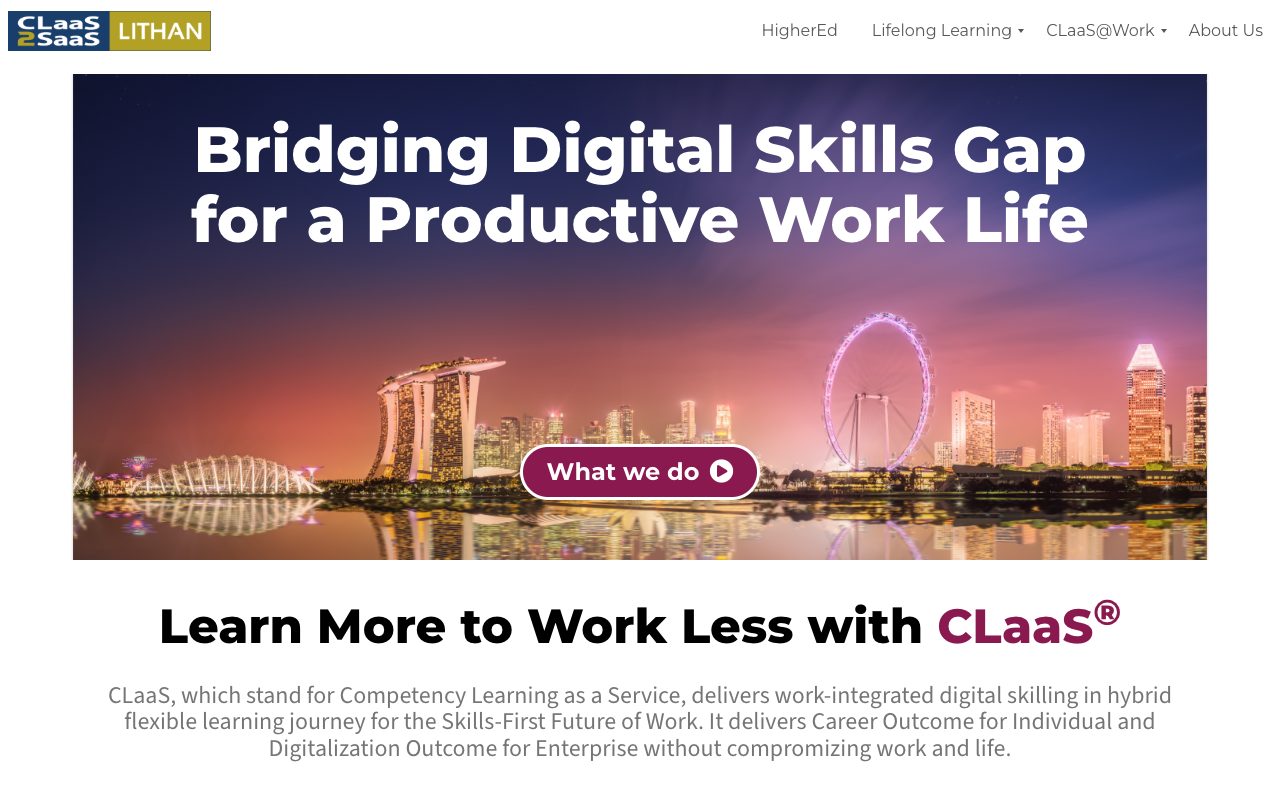
Homepage of Lithan Academy, captured 2026-10-18
Lithan Academy's homepage, captured 2026-10-18. Shown for identification and comment; it may differ from the award-winning implementation.Open live site ↗

Provides adult education to bridge AI skills for a productive workforce

Published key challenges

  • Lengthy curriculum development. A 60-hour module required around 300 staff hours to map competencies, prepare content, assessments and rubrics
  • Difficulty scaling personalised learner support. Learners progressed at different speeds, while limited trainer capacity made it difficult to provide timely, customised support
  • Delayed learner intervention. Attendance, assignments and programme progress tracked separately, making it harder to spot learner issues in-time.

Adaptive CLaaS: AI-powered Personalised Learning System

  • AI-assisted curriculum development: CLaaS Developer uses generative AI to create first drafts of learning pathways, session plans, content and assessments, with AI-assisted quality checks and curriculum teams reviewing and refining outputs
  • Adaptive personalised learning: CLaaS Mentor adjusts learning pace and difficulty based on learner progress and recommends resources for identified gaps
  • AI-powered learner support: Provides on-demand guidance, reminders and automated assessment feedback, while escalating learners that need more support
  • Data-driven learner management: CLaaS Manager consolidates enrolment, attendance, assignment completion and programme progress into a 360 view
  • Human-in-the-loop learning delivery: AI handles repetitive curriculum development and routine learner guidance, while curriculum teams and trainers retain responsibility for content quality and complex interventions

02SCQA case study

351 words
SSituation

Lithan Academy provides adult education intended to bridge AI skills for the workforce. Its model is Competency Learning as a Service, which combines structured curricula with work-integrated learning. Course development is the production line: a module must map to competencies, carry content, assessments and rubrics, and survive quality review.

CComplication

A 60-hour module required around 300 staff hours to map competencies and prepare content, assessments and rubrics. Learners progressed at different speeds, and limited trainer capacity made timely, customised support difficult. Attendance, assignments and programme progress were tracked separately, so learner problems surfaced late. The organisation was constrained at both ends: slow to produce a course, and slow to notice a learner falling behind. Both constraints hit the same budget line, so investment in course production competed directly with learner support.

QQuestion

How could the academy produce courses faster and support each learner individually, without diluting curriculum quality or losing trainer oversight?

AAnswer

Lithan built Adaptive CLaaS, an AI-powered personalised learning system in three modules. CLaaS Developer uses generative AI to draft learning pathways, session plans, content and assessments, with AI-assisted quality checks and curriculum teams reviewing and refining the output. CLaaS Mentor adjusts pace and difficulty based on learner progress and recommends resources for identified gaps, while providing on-demand guidance, reminders and automated assessment feedback, and escalating learners who need more support. CLaaS Manager consolidates enrolment, attendance, assignment completion and programme progress into a single view. The citation reports 75% faster curriculum development, 60% less manual monitoring and support, and about 60% year-on-year revenue growth. The human-in-the-loop boundary is explicit: AI handles repetitive drafting and routine guidance, while curriculum teams and trainers remain responsible for content quality and complex interventions. The citation does not report learning outcomes or completion rates, so the effect on educational quality, as distinct from production speed, is unmeasured. Revenue growth is the least attributable figure in the citation, because course production speed is one input among several, alongside demand for AI skills, pricing, and the sales capacity to fill the additional courses produced. Completion and pass rates would show whether faster production improved learning or merely accelerated it.

Implementation takeaway

Generate the draft, not the decision. Curriculum teams kept authority over quality, which is what made the speed gain safe to sell.

03Verified business results

Company-reported
Published business outcomes for Lithan Academy, as reported in the award citation.
MetricPublished resultAttribution
Curriculum development75% fasterCompany-reported; published in the IMDA/SBF award citation
Manual monitoring and support60% lessCompany-reported; published in the IMDA/SBF award citation
RevenueAbout 60% year-on-year growthCompany-reported; published in the IMDA/SBF award citation

The award citation publishes relative changes and absolute volumes, not paired before-and-after values. Baseline figures are therefore not shown, and no improvement percentage has been calculated from them.

04Technology stack

Evidence status per layer
Technology stack for Lithan Academy, with evidence status for each layer.
LayerImplementationVendor / in-houseEvidenceSource
AI modelGenerative AI for curriculum drafting and assessment feedbackNot disclosedunknownStatedT0-AWARDS
ApplicationsCLaaS Developer, CLaaS Mentor and CLaaS ManagerIn-house, unnamedin-houseStatedT0-AWARDS
ProcessingAdaptive pacing and resource recommendationIn-house, unnamedin-houseStatedT0-AWARDS
IntegrationEnrolment, attendance, assignments and programme progressNot disclosedunknownStatedT0-AWARDS
GovernanceCurriculum team review and trainer responsibility for qualityIn-house, unnamedin-houseStatedT0-AWARDS

A layer marked inferred includes a documented basis. Layers without a named vendor are left unnamed rather than filled with a plausible product.

05Implementation diagrams

Documented vs illustrative
Documented implementationEvidence-bounded
CompetencyrequirementsCLaaSDeveloperdraftingAI qualitychecksCurriculumteam reviewCLaaSMentoradaptationCLaaSManager 360viewDeliveredmodule andlearner…INPUTPROCESSAISYSTEMHUMANOUTPUT

Components named in the award citation.

Illustrative reference architectureIllustrative only
CompetencyframeworkDraftgeneratorwith…Rubric andassessmentbuilderSubjectexpertreviewLearningmanagementsystemLearnerprogressdashboardINPUTPROCESSAISYSTEMHUMANOUTPUT

A feasible build for another training provider. This is not Lithan's production system.

06Unconfirmed — technical inference

Not attempted

No public technical details were identified beyond the official award description. This case is not supported well enough to justify a technical inference, so none is offered.

07How another SME could build something similar

Advisory, not the winner's method

This section is guidance for other companies. It is not a description of what Lithan Academy did, and it is not endorsed by them.

Suitable for

  • · Training providers
  • · Corporate learning teams
  • · Universities and polytechnics
  • · Professional certification bodies

Minimum requirements

  • · A written competency framework
  • · Past courses with expert-reviewed versions as reference
  • · Trainers with authority to reject generated content

Three implementation paths

Level 1

Drafting assistant

Use a language model to draft session plans and quiz items from an existing outline.

Use when: Development time is the bottleneck.

Level 2

Structured generation pipeline

Generate against a competency framework with templates, rubrics and expert review.

Use when: Multiple modules and consistent quality are required.

Level 3

Adaptive learning system

Add pace adaptation, automated feedback and consolidated learner monitoring.

Use when: Learner support capacity is the constraint.

Suggested sequence

  1. 1Pick one module and measure current development hours
  2. 2Generate drafts against the competency framework with strict templates
  3. 3Have subject experts edit and record their changes
  4. 4Use the edits to tighten templates before scaling
  5. 5Add learner monitoring once content production is stable

Tools and alternatives

  • · Language model with long-context drafting
  • · Learning management system
  • · Assessment and rubric templates
  • · Analytics dashboard

Risks and PDPA considerations

  • · Generic content that passes review but teaches nothing
  • · Assessment items that leak answers
  • · Over-automation of feedback that learners need from a person

KPIs to track

  • Staff hours per module
  • Expert edit ratio
  • Learner completion rate
  • Assessment pass rate
  • Trainer hours per learner

08Research gaps

What remains unknown
  • No model provider is named.
  • Revenue growth is attributed to the AI system but other commercial factors are not excluded.
  • No independent evaluation of learning outcomes is published.

Are you this company? Submit documentation to upgrade your evidence grade.

If you have published technical documentation, vendor whitepapers, or third-party audits, submit documentation to our research desk. We update evidence grades upon verification.

09Sources

4 records
  1. Infocomm Media Development Authority (IMDA) and Singapore Business Federation (SBF) · 16 October 2026 · Retrieved 18 October 2026 · T0 — Canonical awards source

    Canonical source. Page last updated 16 October 2026. Publishes one profile per winner: company description, three key challenges, named AI solution, solution components and three headline metrics. No individual winner URLs are published.

  2. Infocomm Media Development Authority (IMDA) · 13 October 2026 · Retrieved 19 October 2026 · T1 — Direct primary source

    Official government media release for SMEs Go Digital Day 2026 and inaugural SME AI Impact Awards at Suntec Singapore Convention & Exhibition Centre. Minister Josephine Teo presented awards to 30 SMEs.

  3. Lithan Academy · Retrieved 18 October 2026 · T1 — Direct primary source

    Company describes Competency Learning as a Service and AI-powered enterprise digitalisation.

  4. PR Newswire APAC (IMDA media release) · 21 May 2026 · Retrieved 18 October 2026 · T1 — Direct primary source

    Announces the inaugural awards, the two categories, the 30-winner ceiling, the Trustmark, and the 13 October 2026 announcement date.

Researched 18 October 2026 · Updated 18 October 2026 · Award citation retrieved 18 October 2026.

Lithan Academy is a winner of the SME AI Impact Awards 2026, organised by IMDA and SBF. This case study is independent analysis and is not an official company publication.

Related case studies

Similar technology and sector implementations

Homepage of Lil' but Mighty Education Centre, captured 2026-10-18
Adoption ExcellenceEducation
Winner · Award Cohort 2026

Lil' but Mighty Education Centre

Lil' but Mighty cut parent communication turnaround by up to 83% and saved over 6,200 hours a year.

Marketing output
300% increase
Content generationBCanonical source supported
Homepage of Accountingbpo, captured 2026-10-18
Innovation ExcellenceBusiness Services
Winner · Award Cohort 2026

Accountingbpo

Accountingbpo turned a headcount-bound accounting back office into a supervised AI workflow.

Accounting document processing time
Up to 67% reduction
Document processingBCanonical source supported
Homepage of iAPPS Health Group, captured 2026-10-18
Innovation ExcellenceHealthcare
Winner · Award Cohort 2026

iAPPS Health Group

iAPPS Health Group built an AI-native clinic operating system and lifted doctor productivity up to four times.

Doctor productivity
Up to 4x increase
Clinical decision supportBCanonical source supported